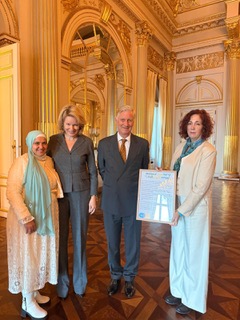
Dr. Tagrid Yousef, Dinslaken, Germany, mother of two daughters, neuroscientist—international networker—peace ambassador
Tagrid is an active member of the WWP/WOS Germany support group and involved in various projects. 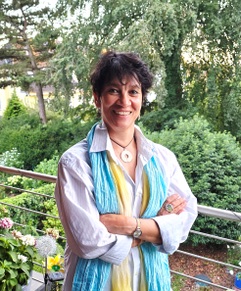
There are events that divide one’s life into two parts: “before” and “after.”
On October 7, 2023, I was in Palestine with my daughter. What had begun as a visit with family and friends turned, within three days, into a situation that shook our lives to the core and changed them forever.
News of the Hamas terrorist attack spread quickly. Fear hung in the air. Streets emptied, checkpoints were reinforced, certainties vanished, and settlers took control of the streets. For my daughter, the situation was terrifying. She was afraid—a fear no child should ever have to experience.
I, too, was afraid.
But as a mother, I had little room to show my own fear. I’ve experienced many situations during my time in Palestine: curfews, military presence in the village, harassment, discrimination at the border and at checkpoints. But this was something I’d never encountered before. My role was different now. I had to provide support, radiate confidence, and try to offer guidance while I myself was searching for orientation.
The people in our village treated us with great care. They tried to reassure us, even though they themselves didn’t know what the coming days would bring. Many of them knew the reality of uncertainty, restrictions, and sudden changes in daily life better than I did. I will never forget their humanity and their willingness to help.
While other countries began evacuating their citizens, we found ourselves in a difficult situation. The uncertainty about whether and when we would be able to leave weighed heavily on us. As German citizens with a Palestinian identity, we unfortunately were not among the privileged few who were evacuated. Second-class citizens once again! Eventually, with a lot of help from close friends, we managed to leave via Jordan—all of a sudden, without being able to say goodbye.
On October 10, we arrived in Amman.
But even there, the tension didn’t subside. The news from Israel and Palestine kept coming in. Families were separated from one another. People feared for their loved ones. Images of violence, suffering, and destruction were everywhere. We waited for our flight back to Germany while trying to stay in touch with family and friends.
Those days changed me.
When I returned to Germany, I knew I couldn’t just go back to business as usual. I didn’t want to be just a bystander. I wanted to make a contribution—no matter how small it might be.
I had been following the work of Women Wage Peace and Women of the Sun for a long time. Time and again, I had come across their initiatives. Time and again, I was impressed by the courage of these women, who—despite all their differences and despite a decades-long conflict—are committed to dialogue, encounter, and peace.
At the same time, I witnessed how Germany was changing. Racism, discrimination, and anti-Semitism were on the rise. Since then, Palestinians, Jews, and Muslims have faced extreme hostility. I have experienced all of this firsthand almost every day, and it was clear to me that, based on my understanding of democracy, I wanted to make a difference here.
After October 7, I came across the work of Women Wage Peace and Women of the Sun once again. This time, the thought wouldn’t leave my mind.
While political debates are often marked by finger-pointing, ideologies, and mutual accusations, I heard something different from these women: humanity.
They spoke about their children. About their families. About their fears. About their hope.
They didn’t talk about who should win. They talked about how people can live.
There are thousands of women, in Palestine and in Israel, who are active in the peace movements. These women show that peace work doesn’t begin in conference rooms.
It begins with people. With mothers, daughters, grandmothers, friends, and neighbors.
With women who refuse to give up hope.
The women of Women of the Sun and Women Wage Peace represent countless women around the world who, every day, build bridges, listen, comfort, protest, pray, sing, organize, and believe that a different future is possible.
These women teach us to listen, to give space to their voices where they are all too often overlooked. Because behind every headline there are people.
Perhaps peace doesn’t begin with major political decisions.
Perhaps it begins with the courage to listen to others.
.