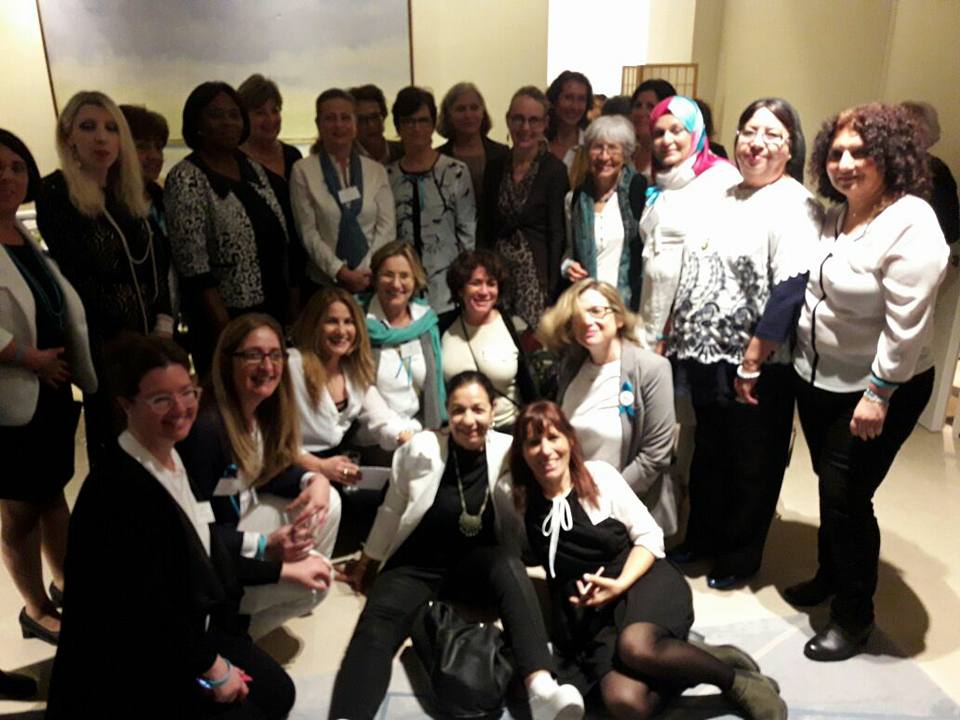
I am very honoured to be part of the Women Ambassadors for Women Wage Peace initiative. I first met members of the movement in late 2015 after my arrival in Tel Aviv and Ireland has been strong among the card-carrying or should I say bracelet-wearing international supporters of Women Wage Peace since then – and we intend to do even more in the future.
Having lived through the period of what we call the “Troubles” in Northern Ireland from the late 1960s to the 1998 Good Friday Agreement and its implementation to the present day, I have seen first-hand the contribution which women make to peacebuilding and to creating hope and inspiration that peace is possible and must be achieved. I have also realised that affirmation, recognition and practical support are essential to maintaining momentum, engagement and progress and that is what we women Ambassadors would like to contribute in the period ahead.
In these brief remarks, I decided to focus on three particular standout periods for me – 1976, 1996 and the current time.
A terrorist incident in Belfast in August 1976 spurred two women to create what became known as the Peace Movement of Northern Ireland with a clear and simple message: we must put an end to the use of violence and to acts of terrorism; we must build our future on peace and cooperation. For their work, Betty Williams and Mairéad Corrigan Maguire were awarded the Nobel Peace Prize. While their movement did not stand the test of time, the incontrovertible fact remains that they took the first courageous step along the road to peace as have Women Wage Peace here in Israel, in the face of despair after the 2014 Gaza war. I know that I speak for all my diplomatic colleagues in admiration and celebration of the robust and egalitarian structures you have set in place to ensure the sustainability and inclusivity of your movement and the broad and diverse programme of activities and actions you undertake.
Moving on 20 years, the Northern Ireland Women’s Coalition was established in 1996, following extensive discussion about the virtual invisibility of women in politics in Northern Ireland, which contrasted with the large numbers of women activists at local community level. The NIWC was a non-traditional party, constituted in the main of women civil society leaders who felt disenfranchised by the male-dominated political status quo. It had an agenda shaped by “bread and butter” issues they felt were lacking in formal politics – education, economic opportunity and security affecting their daily lives. It succeeded in achieving representation at the Forum for Political Dialogue, the forerunner of the multi-party talks which resulted in the Good Friday Agreement in 1998, with the express purpose of serving as a voice for women on both sides of the conflict. The NIWC had significant impact in three core areas: their role as an honest broker, facilitating dialogue between opposing parties; their success in integrating issues and language into the Good Friday Agreement that might otherwise have been omitted; and their positive effect on women’s political participation. Though formally disbanded in 2006, its members continue to support the involvement of women in public and political life in Northern Ireland.
Over 20 years later again, Northern Ireland saw fresh elections last week following the unfortunate breakdown in the power-sharing executive less than a year after the previous election, precipitated by a domestic issue (a renewable energy scheme). As I watched the results coming in last Saturday afternoon, I was struck by the numbers of active, articulate women on my screen. 30% of members of the new Assembly are women, a record high. Since men were more likely to have been involved in violence in Northern Ireland and as the power-sharing arrangements are predicated on getting organisations and individuals formerly involved in violence to engage in peaceful political participation, women have had to overcome many barriers. It is noteworthy, against this backdrop, that three of the five political parties in the new Assembly are led by women including the two main players. The Democratic U*nionist Party and Sinn Fein who have the challenging task of trying to form a new power-sharing Executive in the next three weeks. While deep-rooted differences exist, it is fair to say that the bulk of the negotiations will be on issues on the domestic political agenda, the bread and butter issues I mentioned earlier, and about the future rather than the past.
The path trodden by women peacemakers in Northern Ireland has not been easy and we should not hide difficulties and disunity, reflecting the broad tapestry of divergent politics and traditions. But women have made a difference and I hope that some of their experience will assist Women Wage peace in your main goal of reaching an honourable and bilaterally acceptable political agreement to the Israeli-Palestinian conflict.
We wish you well and we will do all that we can to help you along the way.