Gan Yavneh 2017 דרשה לפרשת שלח לך
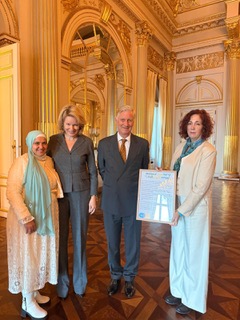
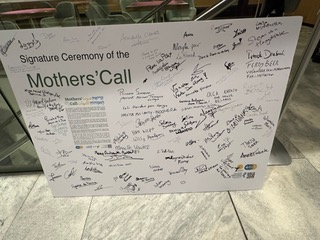
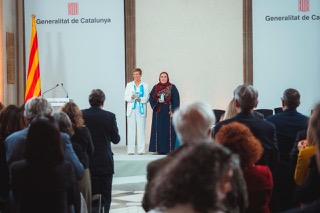
I attended a conference named Building a Shared Future this week hosted by three NGO organizations: ADAM, Itach and Women Wage Peace, a movement including Arab, Jewish, secular, and religious women, settlers, and kibbutznikim amongst its membership. The shared goal of all these women is to spur the Israeli government to forge a political agreement to end the Palestinian-Israeli conflict. The organization does not express an opinion on the nature of that agreement – whether it be two-state, autonomous, federal, or some alternative. The only goal is the achievement of an agreement that would end the ongoing bloodshed.
The two-day conference renewed my thinking on the weekly Torah Portion Shelach Lecha. God commands Moses to send scouts to explore Canaan. The required agent of each tribe brings the band of spies’ number to 10. There is not a single woman among this chosen dozen. Thus the viewpoint of those who bear life, grow wheat, knead dough, feed children, weave cloth, heal with herbs, and carry water from the well is lacking. Mothers were not sent to examine Mother Earth’s quality in the Land of Canaan. Women were not taken into account when we were dispatched to investigate the identity of the people and the benefits of the new and Promised Land.
Not coincidentally, most of the men returned from this journey with a harsh report: A land that consumes its inhabitants; filled with giants and fortressed cities; with Amalek living in the Negev. This fear-driven report increases despair and sows panic. The result is immediate. The People of Israel weep and complain. Hysterical rumor has it that it would have been better to stay in Egypt or the desert, painting a dismal picture: “Why is G-d bringing us to this land to die by the sword? Our wives and children will be captives! It would be best to go back to Egypt! [Shelach Lecha 14:2-3]”
Two men, Caleb ben Yefuneh and Joshua ben Nun, thankfully offer minority opinions reflecting a somewhat different perspective. It’s a good thing that “majority rules” was not cited to silence them and that they were free to express their exceptional opinions without fear for their lives or their livelihoods.
Back to the Women Wage Peace conference – In my opinion, the most fascinating session was that of Huda Abu Arqoub, the Regional Director of Alliance for Middle East Peace. Huda is a young, educated, critical, and remarkably impressive woman. Huda’s well-established premise is based on a finely honed analysis of the last 100 years of the conflict. It contains a formulated vision of a much, much better future for all the residents of this blood-soaked soil. She is not afraid to confront Israelis, Americans, Arab nations, Palestinian Authority leadership, fundamentalist Muslims, or any other body that to her mind throws a wrench into the vision of a life of liberty, freedom, peace, and economic and cultural prosperity for people in our shared space. She also has a well-developed plan for advancing that vision.
What really got me about Huda’s lecture was the series of fascinating and surprising facts that she threw out to the audience. This astounded me: 97% of Palestinians can read and write. Only 3% are illiterate. There are 15 Palestinian universities and technological and research institutes. Sixteen percent of the judges in their courts are women and women head four of the Shariya religious courts equivalent to our Rabbinical courts. Three thousand computer science graduates enter the job market each year and the research and development departments of Palestinian high tech companies are the only departments in the Arab world that maintain close contact with a number of international mega-factories. Huda explains that this illustrates how the sane majority on both sides must unite to wield power and determination against the small, extreme minority, driven by nationalist ideology and religion to sabotage the idea that we may all live in sustainable peace.
UN Resolution 1325, outlined in another lecture, seeks to advance women by placing them in key public and foreign and defense positions in the UN member states. Experience throughout the world teaches that inclusion of women on conflict resolution committees promotes more stable, enduring, and broad-based addressing a broader public. This relies on the principle that women see things differently, develop different lines of communication, and build different bridges in order to benefit their children.
It suddenly dawned on me – while Huda was presenting illustrative points at a dizzying clip and in fluent and articulate English – that what we lack are scouts to explore the Land of Canaan. Delegations composed this time of men and women to cross the Separation Fence and learn about the land. A land in its entirety the land of our fathers now inhabited by 350,000 of our Jewish siblings and 3 million Palestinian cousins. We must go forth and explore it. Not in secret – but openly. We must meet and talk. We must study the nature of cities we view as fortified against us. Who are these giants who scare us so? Maybe the minority opinion that we can live together is right.
Translated from Hebrew by Varda Spigel